Showing posts with label Indigo bunting. Show all posts

Sunday, May 4, 2008

Colorful Visitor Arrives


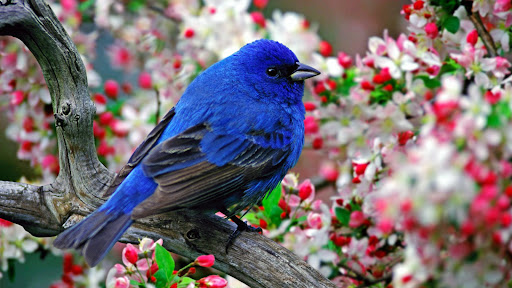
Early in April there is a colorful visitor that comes to our area. He is one of our first returnees from the tropics for the summer.

Indigo buntings appear in the Central Savannah River Area about the time lawns, roadsides and meadows are filled with dandelion seed puffs and when crabgrass, sock and other weeds spring up.

When we first moved to our present location, indigos visited us every spring. We had a little pool situated under small pines in the backyard. Looking back, I see where our backyard was probably a cotton patch at one time. Through the years it was abandoned as a field and now was being taken over by mostly pines, thick vines, shrubbery and residences.

Indigos had probably used this space for nesting, rearing young and singing from high perches from time immemorial. Birds are known (by banding) to return to the former year's nesting sites with regularity. Now we have taken their home site for our own, for we don't see them around the yard anymore.

Indigos are small birds measuring only 5 1/2 inches from bill tip to tail tip. The adult male indigo is our only small, all blue North American finch. In the fall, the male molts into plumage much like the female but there is always enough blue in the wings and tail to identify him. During the fall molt he could be confused with the blue grosbeak but for his smaller size.

Adult females are warm yellowish-brown above pale buff below. She has no discernible streaks or wing bars as other little brown female birds do. Though the young look similar to the female, prominent streaks on the breast tell you who they are.

Indigos seek out brushy cover close to the ground for nesting. But it must be near high perches for the elegant male to sit all day and pour out his exuberant and ceaseless song. A song expert says this about the indigo's song: "One remarkable song that can give an idea of the rhythm was zay-zay zreet zay zay zeah zay-zay- seeteeteet zit-zit zeah." The remarkable thing about this is that the rhythm is exactly like that of a well known human jingle. "Bean porridge hot, bean porridge cold. Bean porridge in the pot, nine days old."

It has been determined that different individuals have songs of many patterns. If you hear a bird singing but are not sure it is an indigo, search it out for certain identification.

Male indigos sing all day throughout the hot days of summer. The hotter the days, the more intense their singing.

Bark strips, weed stems, broad grass blades and skeletonized leaves make up the thick walled nest. It is lined with fine grasses or hair and is usually placed low in the shrubs or branches of prickly vines or bushes. Three to four white eggs with a bluish or greenish tinge are laid. Incubation is 12 days, with nestling fledging in about the same number of days.

Fall migration begins late in August or early September for these brilliant birds and may continue through early November. Some indigos winter in Florida but the preponderance of the massive flocks move on to Cuba, Mexico and Central America.

You will know another season has rolled around when you no longer hear the incessant singing of the indigo.

Monday, March 24, 2008

The Bewitching Beauty of the Bunting


Two of our most beautiful buntings will fly in on the soon to be fragrant-filled, moon-silvered April nights. Both species, the painted and the indigo, nest in the Aiken-Augusta area.

The painted is thought to reach its most northern and inland nesting habitat near Augusta, GA at the fall line along the Savannah River. It breeds each spring, though sparingly, in the river bottoms, other low-lands, brier patches and hedgerows.

At one time, Augusta was the only locality in Georgia where the painted bunting bred, or even occurred regularly. Merry Brothers brickyard ponds had several breeding pairs observed each spring.

Wrapped in a patchwork-quilt coat, including his intense violet-blue head and vermilion breast, this 5 1/4 inch bunting is a dazzling beauty. There is no blending of hues of the startling colors but each is definitely defined, as if they are hemstitched together.

A beauty in her own right, and outfitted in a green to yellowish-green dress, the female is one of the truly green birds found in the United States.

In her sparkling green dress, she primps before the dun-colored females of other sparrows and buntings. She knows she's a glowing beauty. The adult male wears his patchwork coat the year-round.

In the last decade or so this colorful little bunting has been observed in Aiken, South Carolina, males in summer, females in winter at feeders.

Arriving about a week before the females from their tropical vacation, courtship begins almost immediately with the male strutting and flying before his intended mate. The lethal battles begin with males fighting for a certain beauty.

Those who have witnessed these battles say they are savage and are often fatal. It just goes to show you can't judge a gentleman by his clothes.

On a warm southwest breeze the indigo bunting comes riding in with a song in his heart. He is a high-spirited little tad in indigo blue. His color changes from dark blue to dark greenish or even blackish as the sun strikes him from different angles. He is a persistent singer and immediately buys up his real estate with song.

While awaiting his mate to arrive, the deep-blue colored male spends his time on the highest singing perch available, pouring out his bewitching song to all who will listen.

He is an impressive and persistent singer and everywhere through all the hot days of May, June, July and August you'll hear his cherry "Swee-swee-swee, swee, swee, sweet-sweet-sweet, swee-swee" from his favorite treetop perch.

When courting, this blue-clad casanova follows the tiny brown-dressed female hour after hour, with hardly a pause in his serenade, until she succumbs to his wiles.

After family duties are ended, the male indigo starts drifting southward with his fellows. He changes his blue serge suit to brown coveralls with pockets stitched in the faintest blue. She follows a few days later dressed in her own little brown dress.

In late summer, out in the field, you are aware something is missing, but what?

As the morning wears on, you hear only one lone indigo singing, and it hits you!

Summer is riding away on the back of a little blue-feathered tad.