Monday, May 12, 2008

When Squirrels Go From Cute To Pest


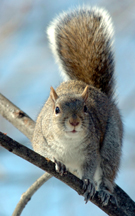
The most often asked question of me today is not "What bird is that?" but "What can I do about squirrels?"

The squirrel, of course, is a rodent, a cousin of rats , mice, moles, muskrats, beavers and all gnawing creatures with sharp chisel-like teeth.

Most bird watchers who keep feeders filled with seed for the birds are exasperated by squirrels. Nuts and acorns, the fruit of forests and woods, have been for eons the basic diet of squirrels. But bird watchers have changed that. Now I think we can safely say it is sunflower seeds, at least for the city-bred furry creatures.

Squirrels will eat buds, fruit, berries, insects and even young birds. They attack the young bird in the head region, cracking open the skull as if it were a nut.

We know of its fondness for buds. Early this spring we transplanted a red maple. As the buds appeared the squirrels ate them, stripping the bark and limbs off a 2-foot section of the trunk. They almost girdled the tree. Of course, with the cambium destroyed, the tree would die.

Being prolific breeders, squirrels observe two breeding seasons, spring and summer. They are active throughout the winter. Squirrels used to rely on stored food to get through the cold months. Today they rely on bird feeders, that is, again, the city fellows do.

But now, how to squelch squirrels? We learned from an Aiken friend of a product called Squirrel Away that is guaranteed to do the job. All you do is mix the product with bird seed and the furry creatures will shake their fuzzy tails at you for ruining their banquet. Squirrels hate the taste. Birds love it. We have used it and it does work. Follow the directions carefully. Here's a link to the company's website: http://www.squirrelaway.com/ .

Nurseries and hardware stores sell other products claimed to be squirrel proof. Nature magazines have many products that are advertised as squirrel proof. Scan the ads in magazines and then go have a look at bird feeders and other products in stores and make your choice. But don't raise your expectations too high . . . I haven't seen a product yet that is 100% squirrel proof.

The following suggestion was gleaned from Birds and Bloom: A creative young fellow drills a small hole in the bottom of plastic soda bottles. He then strings them together on a wire hung between two trees. With six bottles on either side of a feeder hung on the middle of the wire, he says when the squirrels try to walk the wire, the bottles roll and throw them off.

Squirrels . . . are they demons or darlings? When you have only one or two on your lawn they're darlings. When you have a band of five or more eating all your seed, they're . . . well you say it!

Sunday, May 11, 2008

Air Mail?


Lively Sprite On The Scene


The air is vibrant with nuptial song. A male orchard oriole is singing from a tall willow. His mate brings pieces of long, green grass and entwines them into the basket nest hanging at the end of a water oak's sweeping branch.

From a nearby cottonwood, a male summer tanager interrupts his song every few seconds to give his harsh distress note, "quick, pick-it-up." (Say it fast and deep to get the tempo of the note.)

From deep within the thorny thicket, a gray catbird is singing his song. A yellow-breasted chat is chuckling from the brier patch. "Witchity, whichity, witchity." A secreted yellow-throat lets us know he is about but he's not showing himself.

Through all this tuning up and singing, I hear a tiny, high pitched note, like the plucking of an elf's guitar. I listen. "Tsing, tsin--g," it calls. Searching through the greening leaves, I see the owner. Agile, petite, gray-blue and white, with flashing long, black, white-edged tail, the blue-gray gnatcatcher is greedily downing its breakfast of insects. Its beady eyes dance from behind a tiny white ring of feathers, accented by its black forehead and black eye-stripe. It wears an immaculate white shirt. Its slender tail is held cocked like that of a wren.

This little sprite is more abundant in the winter here in the Central Savannah River Area when the northern nesters come down to enjoy southern hospitality. Some migrants even hop the Gulf to Guatemala and the Islands for the colder months.

Measuring only four and a half inches from his thin bill to the end of his twitching tail, it breeds over a large part of the United States.

Its nest resembles that of a hummingbird's, though it's some three or four times larger. Four or five tiny bluish-white eggs are laid. They are loosely sprinkled with reddish-brown dots. In the northern part of their range, these petite birds rear but a single brood in a season but in the deep South two broods are normal.

When a novice birdwatcher first sees this small, tail-flicking bird, he will immediately say it looks like a "miniature mockingbird," and he is right. The similarity of the two birds (except for their size) is indeed striking. Both birds have slender bodies, both are gray, though not the same shade, both have long tails, and many of their habits and expressions are alike.

Gnatcatchers are common birds in wooded areas of cities, yet they are not too well known. Perhaps it is because they are "tree birds," small and quick moving. Yet they can be readily distinguished from other small birds . . . chickadees, kinglets and small warblers . . . by the length of their tails.

One of the favorite haunts of these small, pretty and lively birds is residential areas with wooded streets. If you want to know these petite and active birds, grab your binoculars, go outside and search the treetops for them now while they are busy with family duties.

Saturday, May 10, 2008

This Bird's A 'Knock-Out'


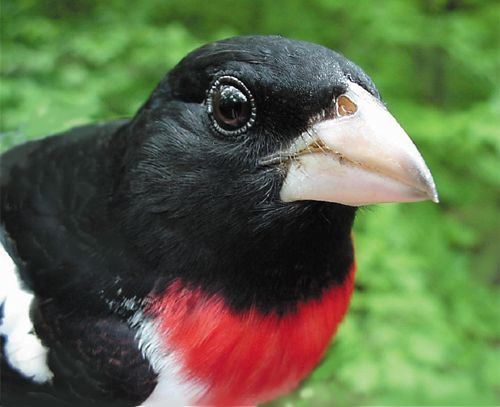
Birdwise, the talk-of-the-town for the past few weeks has been the rose-breasted grosbeak.

Numerous calls from observers who have seen this spectacular bird at their feeders have come from Evans, Martinez, Augusta, North Augusta, Aiken, Beech Island, Langley and other Central Savannah River Area towns. This bird is a 'knock-out' and when you see him for the first time you are dazzled by his beauty.

On their way to northern nesting grounds in the spring, a scattering of a flock drops down to feed and rest all along the route and only a small number is seen each spring. However, when there are numerous spring storms producing rain, hail and wind, migrating birds will come to rest because they can't battle such forces in flight. This will lead to an unusually large influx of birds.

Finding themselves in a new territory, one in which there is plenty of natural food and gobs of bird feeders, they linger awhile, enjoying the warm weather and other amenities of the deep South. From wintering in Central America, the rose-breasted grosbeak arrives in this region from mid-April through early May in a striking new spring and summer suit. The male is handsomely garbed in black and white with a patch of the loveliest bright re-rose on his snow white breast and the most delicate of pink linings on the underside of his wings. The only fault that can be found in the beauty of this feathered Beau Brummell is his big over-sized nose. It seems to overwhelm his black face.

The dowdy lady grosbeak in her streaked dress of brown and grayish white resembles a puffed-up sparrow. She has not a rose-colored feather on her. White eyebrows are noticeable and her bill is thick and exaggerated like her mate's. Her size (eight inches) and big pale bill distinguish her from the sparrows. She wears the same dress the year 'round. No new styles for her.

Rose-breasted grosbeaks do not nest in our area and they are not common residents until you get "way up north" or, occasionally, in the mountains of Georgia and South Carolina.

His song is not unlike that of the robin and we sometimes mistake it for the scarlet tanager, another migrant. You must go to his breeding grounds to hear him, for seldom does he sing on migration.

In fall migration, when these elegant birds return through the area, usually the male still will be wearing his resplendent black and rose dress. As the year advances and he travels to the tropics, he will change outfits.

Changing his dressy duds to an outfit more like the female's, he keeps a tinge of rose on his breast and black and white on his dowdy wings. These small bright spots will distinguish the two.

If you want to attract these birds this fall and in the spring, keep your tabletop feeders filled with sunflower and safflower seeds. A tired migrating grosbeak will thank you, maybe in song, but always in beauty, for easy access to food.

Tuesday, May 6, 2008

The Waders Return


Luscious spring days bring a slew of large wading birds to the Central Savannah River Area. Unless you have a pond on your premises or have access to a neighbor's, you'll have to get out in the field to see these beauties.

You might expect to see the great egret, snowy and cattle egrets, great blue and tri-colored herons and the smaller green heron . . . all elegant and graceful birds.

The cattle egret is a comparatively newcomer to the States, showing up in the CSRA in the early sixties. It is an African egret and no one knows for sure how it found itself in South America about 100 years ago. It is assumed it was blown by hurricane winds from Africa to South America. From there it easily hopped over to the Caribbean Islands. It appeared in southern Florida in the early 1940s.

Augusta birders were expecting it to find its way up the Eastern Coast and in the early 60s it was seen at an Augusta airport for the first time. A new bird in the area! Excitement ran high.

During the breeding season, cattle egrets show buff on their crown, breast and back. The bird appears white at other times of the year, the buff becoming indiscernible. Usually, these striking birds head for the coast for the winter months.

This little egret gets its name by following cows and grabbing up insects disturbed by the grazing cattle. They perch on the backs of cows and other animals and there they find sun-warmed insects. They know a good insect cafeteria when they see one.

Slightly larger than the cattle egret, the snowy can be distinguished from the cattle by its yellow slippers and block stockings. During mating season, it is adorned with waving plumes that curve about its neck, fluttering in the breeze as it feeds and takes care of its young in the nest. Standing over three feet tall on slender black legs and feet, the great egret's entire body is snowy white, accented with straight white plumes on its breast and back when breeding. This handsome egret can be seen at all times of the year in the CSRA.

Another magnificent long-legged wader is the great blue heron . . . a permanent resident of the area, though its numbers increase in the winter.

It's a good thing great blues are well behaved and don't go in for necking. If they did, their long necks would become like the maze of a tangled water hose. Beside his long slim neck, the great blue has long, slim dark legs that lift him to a height of over four feet. A wing span of six feet adds to his splendidness.

Though the tri-colored heron is not common to the area, we do see it occasionally. As its name suggests, its plumage is composed of three colors. The head, neck, wings, back and tail are dark slate-blue. Its belly, rump and under wings are white. The third color, a tawny to dark chestnut stripe, runs the length of the neck.

Arriving in the spring after a winter absence, the unique green heron is back, claiming his "home stead rights" on the border of some miry pond. This is one of the smallest of the large waders. He stands only 16 to 22 inches from his long pointed bill to the end of his stubby tail. A bluish-greenish-gray back is accented by a chubby chestnut colored back. The legs are extremely short for his size.

All herons fly with the neck folded backwards in an "S" curve, their head between their shoulders and their long legs stretched out behind.

These beautiful and graceful birds are out there now. Go see!