Tuesday, April 8, 2008

An Unexpected Surprise


We awake early on a sunny, dewy day to be greeted by the morning chorus. We lie in bed with windows open and try to name all the birds that are singing so delightfully. We pick out the robin, the brown thrasher, the wood thrush, crested flycatcher (two summer visitors), the mockingbird, Carolina wren, the mourning dove, the titmouse and oh my, yes, it's the red-eyed vireo.

In early April these energetic wood sprites return to us from Central and South America where they have enjoyed another summer with plenty of insects. Now they are back to build their nests and rear their young. Come August and September they'll hazard another long journey so they might live in perpetual summer with an abundance of food.

After breakfast we open the doors to the patio and our little dull, olive-green friend is still singing the same monotonous notes. He doesn't stop, but goes on and on with the monotonous song, "Look up, over here, see me, up here" he sings, repeating the phrase as often as forty times a minute. It has now been an hour and fifteen minutes since we first heard his greeting to us. He seems to be working the new growth of foliage on the oaks, maples and sweet gum trees.

The red-eye of this vireo is not a distinctive field mark unless one is close to the bird. A clearer identification mark of this six-inch vireo is the clear white line over the eye, bordered with black. An olive-greenish back with no wing bars and a gray head are more distinctive markings. The under parts are dull white with sides and flanks being washed with a dirty greenish-yellow. The slight hook at the tip of the large bill, characteristic of all vireos, is also a good field mark in distinguishing vireos from warblers.

The red-eye is a common nester in this area. Check your yard borders, all trees on lawns and wood lots and you'll probably find his nest, if he's in your neighborhood at all.

Its nest is made of wood fibers, bark, weed stems, dried leaves, moss and lichens. The small cup-shaped hanging cradle is placed almost to the end of a branch, usually ten to twenty feet from the ground. It is attached to a fork with part of the nest attached to a third twig growing from one of the branches forming the fork, thus forming a parallelogram. All red-eyed's nests that I have seen are placed in such a situation, the clincher that tells you you've found a red-eyed's nest in bare winter woods when no vireos are around.

The nest is about two and one-half inches across and the same, or nearly so, in depth. It is so strongly and compactly built that it can stand the storms of winter. One hung in our yard for three years.

Vireos are our best leaf debuggers. The spastic warblers flit from twig to twig, leaf to leaf, without cleaning the foliage. Vireos, on the other hand, leisurely search each leaf and twig, cocking their little heads to look up at the underside of the leaf and peck off the bugs hidden there.

Vireos work as the seven dwarfs did . . . singing as they work. Sometime sit in the yard and watch them labor.

Monday, April 7, 2008

Flycatchers Arrive


When first you see the great-crested flycatcher in the spring, back from his winter vacation in the tropics, he may look as if he collided with a tropical storm on his way across the Gulf. Sometimes his crest looks ratted, a sign that he is not yet over jet lag.

This bushy, crew-cut bird wears a drab olive coat on his back, accentuated with bright mahogany wings and tail. Its lemon-yellow shirt adds to its camouflage of the yellow-green leaves of spring.

A large flat bill, with bristles at the base to help scoop in those noxious insects, is a good field mark. You hear this bird more often than you see him because his voice is so loud and grating. But with all his roughness, he is beautiful.

Found in our wooded neighborhoods from Florida and the Gulf Coast into Canada, this big flycatcher was once considered a woods bird, not a suburbanite. If in your neighborhood you have large trees scattered with woodpecker holes or natural cavities, he'll probably be your neighbor this spring.

The great-crested is a hole-nesting bird and natural cavities seem to be his preference, though he will build in man-made boxes, mailboxes and other cavities.

Hardly a summer passed that we didn't have at least one flycatcher nest on our bluebird trail. Usually the opening of the boxes used had been enlarged by squirrels.

He has a reputation of always using a snake skin in the nest, and it is still used in many. But because man is such a litter freak, this magnificent bird has become a garbage collector, for we now find in his nest long pieces of plastic and other shiny material carelessly discarded by man. This habit of his collecting shiny strings of material can probably put to rest the centuries old tale that he uses snake skins to frighten away predators. Now, we can assume he uses the natural litter of snake skins as decoration.

Twice on our bluebird trail there was a nest with snake skin hanging from the nest almost to the ground five feet below. It fell between the crack in the door and the wall of the box. Now, how did the bird accomplish this?

Eggs laid by this flycatcher usually number from five to six. They have a ground color of creamy or pinkish buff with streaks, scratches and blotches of brown and various shades of purple or lavender. Incubation lasts about 15 days and the young leave the nest when they are around 18 days old.

By September these youngsters are ready to leave for their winter vacation in Mexico, Central and South America.

During the hot days of lingering July this noisy bird drops the harshness of his "wheep" and becomes more or less quiet. His loud "wheep" of early summer is now toned down to a low, almost insignificant note. In August and early September the note has a sadness to it, almost a mournful intonation, like that of his cousin the wood peewee's mournful fall note, ">pur-eee."

You might say he comes upon the spring scene arrogant and self-determined, flinging out his harsh notes at random. But come early September, with his brashness subdued, he bids us farewell until the next April. He's due now. Look and listen for him.

Saturday, April 5, 2008

From Barns to Bridges


Traveling over the 13th Street bridge into Augusta or clicking along I-20, are you aware of a fork-tailed bird gracefully skimming over the new golf course in North Augusta or over the fields and meadows along I-20? Have you noticed that he darts under bridges, probably fluttering about and checking out last year's nest sites?

Twenty-five years or more ago the barn swallow was only an early spring transient through this area. It nested from the piedmont areas of Georgia and South Carolina and north to Canada and Alaska.

Before this country was settled, the barn swallow nested in caves and on rocky cliffs. The early settlers began to change the land to a rural environment with barns and sheds for cattle and for grain storage. This little metallic blue swallow changed the site of his pad quickly, preferring to plaster his nest on the beams and shelves of such buildings.

Barn swallows are people-loving birds like purple martins. They like to build around houses and dilapidated barns. Though barns are decreasing today, we can lure these swallows to build near us by supplying the needs for a nest site, if we live in the right habitat.

A two-by-four joist, rough, not planed, nailed to the outside of a building, flat, wide side against the wall and placed well up under the eaves with about five inches of clearance will bring them in.

The nest is made out of mud and straw and lined with fine hay and feathers, usually white. Five to six white, reddish-brown spotted eggs are laid and hatch in around fifteen days. Within three weeks, six more young swallows are added to the graceful, engaging flights of the chattering swallows.

These swallows have proved they are adept at change. From the time of the earliest colonists, these beautiful birds chose to build their nests in old weathered barns and sheds with open doors and windows where they could enter to safety from weather and predators.

Barns on farms are not needed today as in the past. They're being replaced by tight new buildings with no open doors or windows that swallows love. Horses are being replaced by automobiles and tractors, leaving the birds to find other nest sites when these older buildings are destroyed or replaced.

Being able to easily change its habits, now one of its chosen sites in under bridges and that is one circumstance that has brought it southward. Until around three decades ago, it was a spring and fall migrant in the Central Savannah River Area. As in the past though, it quickly adapted to man's extended highways and bridges and began to nesting space all along these river-crossing cement spans. Now it is a common breeder in our area.

The barn swallow's food consists entirely of insects caught on the wing as it skims low over ponds, fields and meadows.

Measuring 6 1/2 inches, this dark, metallic blue swallow with glistening reddish-buff breast and deeply forked tail has a light chestnut breast and dark chestnut face. The sexes are much alike, though the female is paler in color than the male.

Monday, March 31, 2008

The Redstart . . . Coming or Going?


When I first see the little tyke he is standing on a rock in the middle of one of the small pools. He timidly puts one foot into the wet stuff, then slips off the rock into the shallow water and begins splashing. After his bath, he jumps onto the rocks around the pool and shakes his feathers dry. Then he flies to a small shrub. From there he darts out into the air and grabs a small insect, flycatcher fashion. Probably a gnat, for swarms are already out.

Leaving the pool, the dazzling little redstart plays among the shrubbery, picking off early hatched insects. From the shrubbery he flies to a slightly leaf-budding sweet gum tree. Sliding along the sun-splashed limbs, opening and closing his orange fan-shaped tail, the tiny bird dances for his breakfast.

Is he here this morning because he remembers his stop at the pool last fall, found it pleasing and refreshing, and now has it on his itinerary for his northward journey this spring?

Dashing out into the air to grab insects, he is likened to the flycatchers, but here his method of securing insects ceases. He is perpetually in motion, seizing gnats and other gossamer-winged goodies in the air. Flycatchers are more sedentary. They sit on a tree branch or fence and wait patiently for their dinner to fly past. Then they dash out and seize it.

The redstart is one of the commonest of the warblers. It is more abundant in South Carolina in the fall than at any other time of the year.

This vivacious little warbler, flashing orange-red tail and wings, gives us a pleasant surprise late in March when he drops into the pool outside our kitchen window.

Most redstarts spend their winter in the West Indies and Central or South America, some 2,000 miles or more from our area. This is an early date for this little guy to be this far north. Because of his earliness, our place is probably just a pit stop for him and in a few days he will be far up the coast, if he has his eye on New England or Quebec. He is probably on his way back to where he was born.

With the exception of the white lower breast and belly, this tiny 5 1/2 inch warbler is dressed all over in black with bright red-orange accents on wing and tail. It has a habit of drooping its wings, fanning out its tail and jumping into the air after insects. It rarely sits still.

The color pattern is the same for the female, though she is grayish olive-green and pale yellow, where the male is flame color and black. Young resemble the female but young males usually have black on the breast and a light salmon wash on the sides of the breast.

Is he a migrant, or has he spent the winter hidden in thick foliage in swamps and along stream banks? If a migrant, he is an extremely early one that hazarded an early arrival, or he has been well-hidden from bird watchers this past winter.

Some Baltimore orioles opt to spend winters in southern swamps and river bottoms rather than seek refuge in tropical forests. Our little visitor may have chosen to do the same.

We didn't hear his "tsee, tsee, tsee-o" song which might mean he hasn't reached his destination yet. Consequently, he'll continue his journey and wait for the females to arrive before he breaks into sweet song.

Sunday, March 30, 2008

Sights & Sounds of a Mountain Childhood


A long time ago I lived in a small village in the North Georgia mountains. In its summers, I enjoyed the simplicity of living and never knew boredom. Those long, sun-filled, mountain- breezed days would last forever, or so it seemed.

There were no radios, televisions or telephones. Communication in the village, over the hills and to distant places came about through mail, foot, automobile, newspapers, books and magazines.

Today's youth would complain, "There's nothing to do. Nothing ever happens here. I'm bored."

But big events did happen in those serene hills. Birds! In April, the big experience was the return of the birds. The coming-home-song of the wood thrush would jolt me out of bed. Quickly dressing, I would rush out into the nippy dawn to find the speckled-throated songster.

And down in the greening orchard, the clear sweet song of the bright indigo bunting bubbled out over the countryside. This small bird began singing as the first sunbeams wrapped the highest hills in light and continued all day long, literally.

For as long as I can remember, phoebes nested on a window frame of my parent's bedroom. We welcomed them home when first we heard the male call in an irritable voice, "phoebe, phoebee," as if he wanted his mate to hurry up and get busy with house building.

Then there's the summer tanager I put to bed each summer night. A big white oak stood below the wall of the front yard and near the road. As darkness crept over the land, I sat under the tree and listened for the tanager's bedtime chatter. "Quick, pick-it-up," he taunted a half dozen times. He seemed to be telling the family to clean up the clutter before hitting the hay. He sputters and spits a few times and then everything is quiet. He goes through this "to-bed" procedure every night, sleeping on the same grizzled mattress under the same green blanket. I wait until he's quiet, then I go into the house. Deepening dusk draws the shutters for the night for both the bird and me.

Our house had a tremendous peaked roof made of weathered shingles. Up from the ground and over the tin-roofed porch, and up the peaked two-story roof, between the two chimneys at either end of the house, ran a lightening rod. It dropped from the peak down the back roof and into the ground at the well porch.

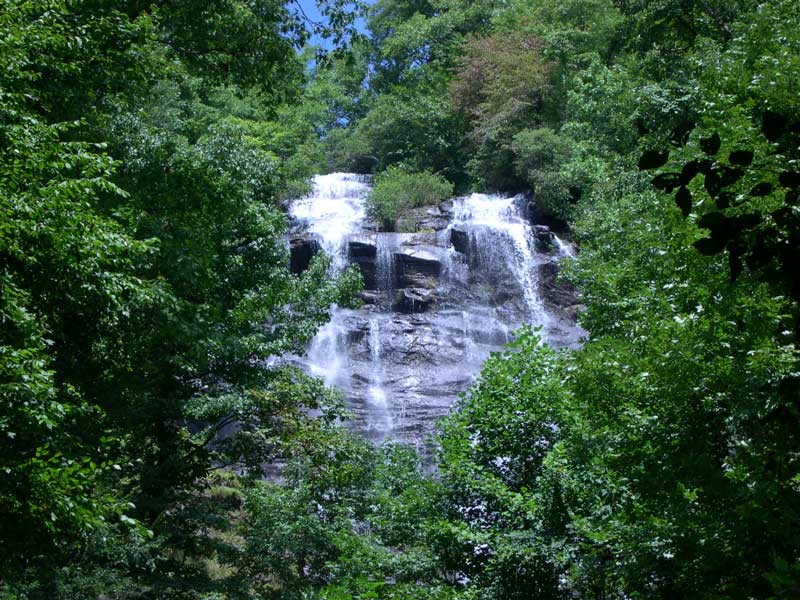
We used to play on the lightening rod. Scrambling up the rod and holding tight, we reached the roof peak. Straddling the peak and grasping the rod, we scampered across the roof to the far chimney. Here, we were in the treetops with the chickadees and titmice and blue jays. And we could look down on the mimosa tree with sometimes a dozen nectar-feeding, ruby-throated hummingbirds. From this exalted position, the horizon expanded over countless mountains and we could see Amicoloa Falls dashing down its rocky slide into a jagged mountain stream some sixteen miles away.

Spanking after spanking we received when we were caught on the roof, but the spankings never deterred us from experiencing this thrill again and again when we could slip to the roof without our mother knowing it.

There's something about the returning birds that sends my senses reeling. The bird chorus that comes with the mountain dawn awakened me to a medley of songs and calls and inspired me to rise with the birds and enjoy the freshness of the morning.

My childhood in the mountains taught me much and has made my life tremendously richer. I feel sorry for today's youngsters who have their sense of wonder of the great outdoors dulled by having only computers and TVs to tell them of the big events of summer days exploding all around them.