Spring mornings belong to the birds. The sounds of a dew-studded morning is bird song at its best.
Light! This is what moves birds to song. The northward moving sun brings more light each day and birds are the first to respond.
Even as the sun teased us these past chilly spring days, birds felt its warm touch, and that touch was overpowering. They began to sing way back in cold February. Now bird song in our area is climaxing, but it will continue until late May and early June. It is then that most summer visitors drop courting antics and close their nurseries, causing song to decrease noticeably.
Nearly all of our permanent residents nest a second or third time. From these nestings we have the mating songs and nursery lullabies until late July and August when both residents and visitors go into molt and song turns into call notes and angry shrieks.
Arising early, shortly after six o'clock, we find a pair of Carolina wrens, who have a nest in a basket of ferns on our porch, already busy feeding the six gaping yellow-rimmed mouths in the cradle. The male stops in a near by river birch between every trip to the nest and belts out a loud, "Shree, shree, shree." His industrious mate works consistently, probably cheered on by his go-go yell.
Where the wood lot meets the wall, there's a robin's nest saddled on a sweet gum branch. Here again the mother is busy with breakfast for four babies while dad adds his melody to the morning chorus. His concert was going before we arose, and he's been at it for an hour now.
Choosing a yaupon holly for their twig and leaf nest, a pair of brown thrashers thrash the debris under the hedge. While he and she dress alike, he soon leaves the thrashing to his new wife and flies to a dead branch of a tall pine where his throaty melody fills the scented air. She leaves the ground where she's feeding and flies to the nest. We watch as she settles down. After sitting, quickly she stands up in the nest again, turns around, shakes her wings, then quickly sits again. There were two eggs in the nest yesterday. We expect three when she leaves this morning.
A southern morning would be drab indeed without the clear whistle of the cardinal as he calls, "What-cheer, what-cheer, what-cheer." He's giving a message to his less brightly colored mate who is busy checking out the cherry laurel hedge. Now, while she hides in the foliage, she sings softly and sweetly to her mate. He stops and listens. When she finishes, he begins a loud and long solo.
Two doves on pink feet swish and sway down the driveway, swinging their little hips from side to side, keeping time with their nodding heads. The dove is a prolific breeder and the two have already built their shallow stick nest high in the crotch of a pine tree. One or the other has been cooing since early morning, a soft, soothing note, compared to the loud boisterous songs of the more active yard birds.
And what would spring be without that master of song, the mockingbird. He is a tireless singer. Sitting atop a twig of a nearly-leafed tree, he sings incessantly hour after hour. We're expecting him to buy building space in the yellow jessamine vine.
He's happy and wants you to know it. The mocker has been known to change his song eighty-seven times in just seven minutes. This outburst of song is as much a part of spring as blooming dogwood trees and flaming azaleas.
Thursday, March 27, 2008

Wednesday, March 26, 2008
I Am Green

Along with the arrival of warblers, another group of dainty birds, though not as colorful as the warblers, will be filling the trees and shrubs in your yards this spring.
Spending their lives among green foliage, vireos wear camouflaged colors . . . olive, olive-green, whitish, buffy or yellowish hues and soft dark grays. Their bills are more curved than the warblers and have a slight hook. The Latin word "vireo" means I am green.
The three species that we are most likely to see in this area are the white-eyed, red-eyed and yellow-throated. The solitary (blue-headed) vireo is a mountain summer resident, nesting occasionally in the piedmont and, rarely, as far south as Lake Thurmond. It is a common migrant through the area, while the red-eyed and yellow-throated are common nesters in the Central Savannah River Area.
Vireos are truly our friends. Watch one search for his dinner. He slowly, deliberately and methodically searches each leaf, above and below it, whereas the excitable, skittish warblers hurry from branch to branch without combing the leaves of harmful insects.
Another way to know you have a vireo in your glasses is to learn their songs. The red-eyed is perhaps the best known vireo in the eastern United States. He wears a gray cap edged in black that sits on his head just above his white eyebrows. His coat is dull olive. It is accented by the white shirt.
There are some birders who think his song is rather tiresome, "you see it-you know it-do you hear me-up here, see me." All through the long, hot summer days, his wearisome monologue, repeated over and over again, fills the humid air. But learn it, then compare the other vireo song's to the red-eyed's.
The yellow-throated is the beauty of the vireo clan with its brilliant yellow breast, its olive green back and its double white wing bars. When you hear it you know it's a vireo because it has touches of the red-eyed's song, but it is more mellow. One song says to me, "e-ay-ee-eight" with a short pause, then repeated. The yellow-throated nests here and is well known by birders in our area.
Another well known vireo of the area is the white-eyed. He wears a brighter olive-green coat than his cousins. His white shirt is washed in yellow on the sides. The two yellowish-white bars on his wings and white throat identify him from a distance. His white eyes are ringed in yellow. This vivacious little vireo wants his own song so he moves away from the typical vireo song. He makes up his own song in chips, chucks and mews which sound like, "chick'-a-per-weeoo. Chick' or chick'-ticha, wheeys, chick!"
The three above described vireos are the most commonly seen in this area. They come in and stay to nest. Three others, the warbling, Philadelphia and solitary vireos spend a few days with us during migration, then move on northward.
If you're not looking for a vireo you might never see one, so inconspicuous are they among the green foliage.
Tuesday, March 25, 2008
Which Bird Built This Nest?
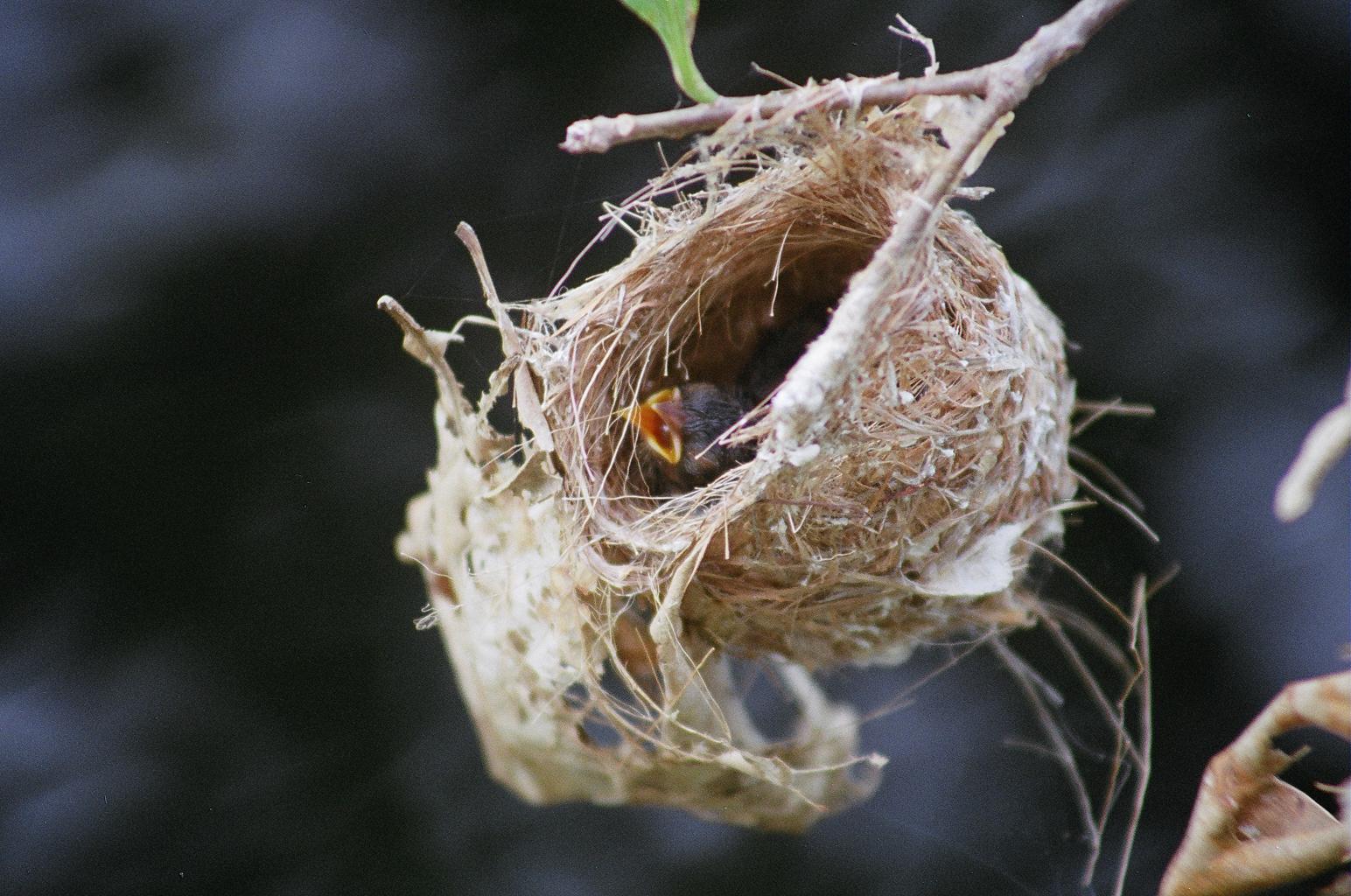
"How do different birds know how to build distinctive nests", queried a friend, "and how can you identify the nests of different species?"
Being addicted to the fine art of finding and identifying bird nests, I tried to answer.
Baby birds are born with individuality and a wild wisdom, a guidance factor known only to them and God. When they hatch they already know how to build a nest like the one in which they were born.
The birds of a given species follow a fairly consistent pattern in nest building although individuals sometimes depart from the general rule, both as to location and materials used in the nest's construction.
Cardinals build nests in our yard every year. Without fail the not-so-neat nests are made of small twigs, strips of paper, weed stems, rootlets and grasses. Fine grass and hair are used for the lining. The nest is from four to twelve feet from the ground in a bush, small tree, hedge or thick and thorny vines.
The yuppie wood thrush has two sets of house plans for the two different sites he usually chooses. His country home is placed in the crotch of a sapling, completely filling the crotch with leaves and paper. The outer depth of the nest can easily reach six inches. Dead leaves, weed stalks, rootlets and paper make up the foundation of the nest. It has some weight because of the compact mud or leaf mold inner wall. It is lined with thin rootlets.
Smaller, shallower and cup-shaped, the other style home is saddled on a large horizontal limb of an aged tree. It is cemented to the branch with mud. The same materials are used as in the country place but in lesser quantities.
We believe the same wood thrush built in the identical crotch of the same sapling in our yard for three years. The act of decorating the outside of the nest each year with a long flowing piece of toilet paper told us we had a hippie decorator in our midst, one who didn't cotton to the traditional decorating styles.
When you find a delicate and cleverly interwoven small cup-shaped nest of dainty grasses and tiny rootlets, lined with horse, cow or deer hair, the petite, rust-headed chipping sparrow is the builder.
To be such a chatterer, and so small, the Carolina wren defies his size with the large rough and sloppy nest he builds. It is lined with fine rootlets and hair. It is domed and has a side entrance.
Any old place will do for him to stick his nest, a hanging flower basket, a discarded coffee pot, a cluttered shelf, baskets, a door wreath, on the top of porch cabinets, underneath automobiles. Lean-tos and crannies seem to fascinate him more than bird boxes for nesting sites.
Of the three mimics, the mockingbird's nest is the smallest, the catbird's is in between, with the brown thrasher building the largest.
All three of these long-tailed birds make their nest foundation with sticks . . . the size stick reflecting who's building the nest. For the second layer of the foundation, the mockingbird and catbird use smaller sticks, but the brown thrasher's second layer is loads of dead leaves, then more small sticks with a lining of fine rootlets.
The catbird's lining is of fine rootlets and grapevine bark, paper and plastic. The mockingbird, after a foundation of small sticks, collects litter for his nest . . . leaves, grass, rags, string, hair, down, tree blossoms, paper, and feathers . . . and lines it with fine rootlets and soft hair.
The red-eyed vireos nesting in our yard always place the nest in a tree close to the end of the limb. They choose not a fork, but a sort of parallelogram (a small branch with two almost evenly spaced twigs protruding from it), and attach the nest to the three twigs.
Yet many of these birds have never selected a location or made a nest before. When the small blind, squiggly, pink animal is born there is within it a food preference, a migrating pattern, a nesting behavior, a distinctive set of marks and song, all waiting to begin that struggle known as survival.
But, with all that said, the best way to identify a bird's nest is to find the owner at home.
Monday, March 24, 2008
The Bewitching Beauty of the Bunting

Two of our most beautiful buntings will fly in on the soon to be fragrant-filled, moon-silvered April nights. Both species, the painted and the indigo, nest in the Aiken-Augusta area.
The painted is thought to reach its most northern and inland nesting habitat near Augusta, GA at the fall line along the Savannah River. It breeds each spring, though sparingly, in the river bottoms, other low-lands, brier patches and hedgerows.
At one time, Augusta was the only locality in Georgia where the painted bunting bred, or even occurred regularly. Merry Brothers brickyard ponds had several breeding pairs observed each spring.
Wrapped in a patchwork-quilt coat, including his intense violet-blue head and vermilion breast, this 5 1/4 inch bunting is a dazzling beauty. There is no blending of hues of the startling colors but each is definitely defined, as if they are hemstitched together.
A beauty in her own right, and outfitted in a green to yellowish-green dress, the female is one of the truly green birds found in the United States.
In her sparkling green dress, she primps before the dun-colored females of other sparrows and buntings. She knows she's a glowing beauty. The adult male wears his patchwork coat the year-round.
In the last decade or so this colorful little bunting has been observed in Aiken, South Carolina, males in summer, females in winter at feeders.
Arriving about a week before the females from their tropical vacation, courtship begins almost immediately with the male strutting and flying before his intended mate. The lethal battles begin with males fighting for a certain beauty.
Those who have witnessed these battles say they are savage and are often fatal. It just goes to show you can't judge a gentleman by his clothes.
On a warm southwest breeze the indigo bunting comes riding in with a song in his heart. He is a high-spirited little tad in indigo blue. His color changes from dark blue to dark greenish or even blackish as the sun strikes him from different angles. He is a persistent singer and immediately buys up his real estate with song.
While awaiting his mate to arrive, the deep-blue colored male spends his time on the highest singing perch available, pouring out his bewitching song to all who will listen.
He is an impressive and persistent singer and everywhere through all the hot days of May, June, July and August you'll hear his cherry "Swee-swee-swee, swee, swee, sweet-sweet-sweet, swee-swee" from his favorite treetop perch.
When courting, this blue-clad casanova follows the tiny brown-dressed female hour after hour, with hardly a pause in his serenade, until she succumbs to his wiles.
After family duties are ended, the male indigo starts drifting southward with his fellows. He changes his blue serge suit to brown coveralls with pockets stitched in the faintest blue. She follows a few days later dressed in her own little brown dress.
In late summer, out in the field, you are aware something is missing, but what?
As the morning wears on, you hear only one lone indigo singing, and it hits you!
Summer is riding away on the back of a little blue-feathered tad.
Sunday, March 23, 2008
Spring Follows Its Own Schedule

The calendar informs us spring has been with us now for three days, but we cannot always depend on spring to exactly follow our calendar.
Azaleas, violets, flowering quince, dogwood and Japanese magnolia were showing color early. Changing weather, now warm, now cold, keeps waking them up and then they have trouble wrapping themselves in their long underwear again for protection in this come again, gone again spring.
The way to tell spring is finally here is when the air is sweet-scented with tea olive, when tender green leaves are popping out all over the boxwoods, sasanquas, blooming azaleas, roses and oxeye daisies are pushing through mulched ground. Spring comes not by calendar's prediction but as an answer to the call of the sun that reaches deep within roots and buds.
Bird songs say spring lies ahead, no matter the rain, or a swing in temperature from 70 degrees to dips of morning lows into the 20s.
One of the most delightful promises of spring is the singing of birds. It is a joy to hear them, a joy to watch their nuptial antics, and a joy to see the beginnings of nest building.
A Carolina wren awakens us from deep sleep on a sunny morning with its loud "sheree, sheree, sheree, tea-kettle, tea-kettle." A cardinal joins in the music. "What cheer, cheer, cheer, cheer" sounds loud and strong. A towhee tweets in the budding azaleas, a chickadee calls his name over and over. When we look out on the front lawn, robins are doing the "River Dance," stiff-legged and unbending straight upper bodies.
Resident birds are already practicing mating songs. The morning chorus gets louder and sweeter and longer each morning. At this time of the season, the choir is made up of local yodelers. They will have picked out locations and some probably will have young before our visitors arrive from the tropics. Then the morning choir grows more beautiful as the voices of our summer guests blend with our local residents.
A goodly number of winter guests will have departed by now, weather permitting, including the dark-eyed juncos, red-breasted nuthatches and purple finches. White-throated sparrows are not in a hurry to leave, some lingering until May. Though millions of red-winged blackbirds opt to stay in the South, millions more are winging northward to nesting grounds in the meadows and marshes, weaving long black lines in the sky.
Within days summer residents will begin to arrive with spring in their throats. The wood thrush, crested flycatcher, orchard oriole, summer tanager, red-eyed, white-eyed and yellow throated vireos jet in through the first weeks of April. Purple martins are here and chimney swifts will be in before the end of the month. The first venturesome hummingbirds, green-backed and ruby-throated, are usually in by the last of March, depending on the blooming flowers.
All our forecasts for the widespread arrivals of our summer guests, of course, depend on the weather . . . spring's only true calendar.
Subscribe to:
Posts (Atom)
